
How to Buy Your HalalFolio
This guide walks you through purchasing the ETFs in your HalalFolio portfolio. Whether you're investing a lump sum or setting up monthly contributions, we'll cover each step from opening an account to maintaining your allocation over time.
The Four Steps
| Step | What You'll Do |
|---|---|
| 1. Open | Choose the right account type for your goal |
| 2. Fund | Deposit money into your brokerage |
| 3. Buy | Calculate shares and purchase your ETFs |
| 4. Balance | Maintain your allocation over time |
Step 1: Open the Right Account
Before you can buy ETFs, you need a brokerage account. Canadian brokerages offer several account types — each with different tax treatment.
Account Types
| Account | Best For | Tax Treatment |
|---|---|---|
| TFSA | Most goals | Growth is tax-free. Withdrawals are tax-free. |
| FHSA | First home purchase | Tax-deductible contributions, tax-free growth for home purchase. |
| RRSP | Retirement | Tax-deductible contributions, taxed on withdrawal. |
| Non-Registered | After maxing registered accounts | Gains are taxable, but no contribution limits. |
Canadian Brokerages
Independent & Fintech — These typically have lower fees and modern mobile apps:
- Questrade — Popular choice, competitive fees
- Wealthsimple Trade — Commission-free Canadian trades
- Interactive Brokers (IBKR) — Best for USD trading, lowest currency conversion, can feel complicated.
- Moomoo Financial Canada — Commission-free trades
- Qtrade Direct Investing — Full-service platform
- CI Direct Trading — Formerly Virtual Brokers
- CG Direct — Canaccord Genuity's platform
Bank-Owned — Convenient if you already bank with them, but typically have higher trading fees ($5-10+ per trade):
- RBC Direct Investing (Royal Bank)
- TD Direct Investing (TD Bank)
- BMO InvestorLine (Bank of Montreal)
- CIBC Investor's Edge (CIBC)
- Scotia iTRADE (Scotiabank)
- National Bank Direct Brokerage
- Desjardins Online Brokerage
Step 2: Fund Your Account
Once your account is open, you need to deposit money:
- Link your bank account — Most brokerages let you connect your chequing account for transfers
- Deposit funds — Transfer your investment amount (this may take 1-3 business days)
- Wait for funds to settle — Your money needs to be available before you can trade
Step 3: Buy Your ETFs
Now for the exciting part — actually purchasing your ETFs!
Your Portfolio Example
Let's say you've chosen to use the 60/40 Model Portfolio. This is a 3-ETF portfolio with the following allocation:
| ETF | Allocation | Description |
|---|---|---|
| MNZL | 40% | Manzil Russell Halal USA Broad Market ETF |
| SPSK | 40% | SP Funds Dow Jones Global Sukuk ETF |
| UMMA | 20% | Wahed Dow Jones Islamic World ETF |
Finding ETFs in Your Brokerage
In your brokerage, search for each ETF by its ticker symbol:
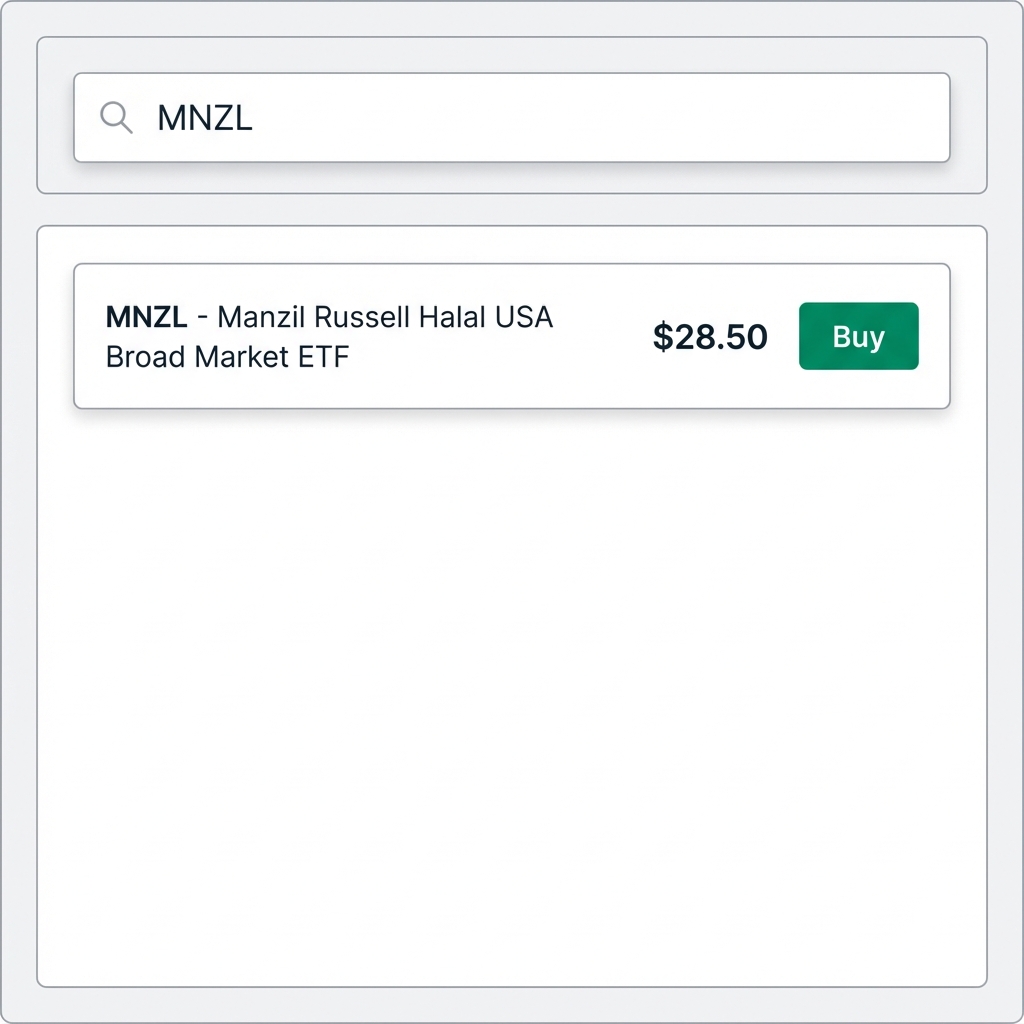
- Go to the Trade or Buy/Sell section
- Enter the ticker symbol (e.g., "MNZL")
- Select the correct ETF from the search results
- Choose Buy
Calculating How Many Shares to Buy
ETFs are bought in whole shares (you can't buy 0.5 shares on most brokerages). Here's how to calculate:
Example: $1,000 Lump Sum
You're investing $1,000 and the current prices are:
| ETF | Allocation | $ Amount | Price | Calculation | Buy |
|---|---|---|---|---|---|
| MNZL | 40% | $400 | $28.50 | $400 ÷ $28.50 = 14.0 | 14 shares |
| SPSK | 40% | $400 | $22.75 | $400 ÷ $22.75 = 17.6 | 17 shares |
| UMMA | 20% | $200 | $25.30 | $200 ÷ $25.30 = 7.9 | 7 shares |
What you'll actually spend:
- MNZL: 14 × $28.50 = $399.00
- SPSK: 17 × $22.75 = $386.75
- UMMA: 7 × $25.30 = $177.10
- Total: $962.85 (with $37.15 remaining as cash)
The leftover cash stays in your account for your next purchase.
Placing Your Order
- Enter the number of shares from your calculation
- Choose your order type:
- Market Order — Buys immediately at current price (simplest for beginners)
- Limit Order — Buys only at your specified price or better
- Review and confirm your order
Step 4: Balance Your Portfolio
Monthly Contributions
If you're investing regularly (e.g., $500/month), run the calculation each month:
| ETF | Allocation | $500 × % | ÷ Price | Buy |
|---|---|---|---|---|
| MNZL | 40% | $200 | ÷ $28.50 | 7 shares |
| SPSK | 40% | $200 | ÷ $22.75 | 8 shares |
| UMMA | 20% | $100 | ÷ $25.30 | 3 shares |
The Proportional Approach
For ongoing contributions, the simplest method is proportional buying — allocate each deposit according to your target percentages:
- 40% of your deposit goes to MNZL
- 40% goes to SPSK
- 20% goes to UMMA
This keeps things simple. Your portfolio won't be perfectly balanced (rounding and price changes cause small drift), but over time it stays reasonably close to your target.
True Rebalancing
For more precise rebalancing, you would:
- Calculate your current portfolio value
- Determine which holdings are underweight
- Buy more of the underweight positions to bring them back to target
Currency Considerations: CAD vs USD
Many Shariah-compliant ETFs trade in US dollars (USD) on American exchanges, while you're depositing Canadian dollars (CAD).
What This Means
- Your brokerage converts CAD → USD when you buy USD-listed ETFs
- Conversion fees vary by brokerage (typically 1-2%)
- On $1,000, that's ~$10-20 in fees
For Larger Investments: Norbert's Gambit
If you're investing $5,000+ at once, consider Norbert's Gambit to minimize currency conversion fees:
- Buy a dual-listed security (trades on both TSX and US exchanges) in CAD
- Request your brokerage "journal" the shares to the US side
- Sell in USD
This can reduce conversion costs from 1-2% to nearly zero. Look up your specific brokerage's process — most support it.
Quick Reference Checklist
- Open — Choose account type (TFSA, RRSP, FHSA, or Non-Registered)
- Open — Sign up with a brokerage
- Fund — Link your bank and deposit money
- Buy — Look up current share prices for your ETFs
- Buy — Calculate shares: (Amount × %) ÷ Price
- Buy — Place your orders
- Balance — Repeat monthly with proportional buying
Platform-Specific Guides
Questions?
HalalFolio helps you research and plan your halal portfolio. The actual buying happens on your brokerage — each has its own help resources and customer support for questions about placing trades.
If you'd like personalized guidance for your specific financial situation, please consult a qualified financial advisor.